Eglinton West (Cedarvale)

I considered writing a simple one-word post for Eglinton West:

Wow.

View looking south towards the Eglinton West entrance doors
The massive coffered atrium ceiling: transformative and breathtaking

But that conflicts mightily with my ultracrepidarian instincts—I can’t help but rave about this station. Like Yorkdale, its sister stop farther up the Spadina line, Eglinton West was designed by Arthur Erickson to visually impress. And it worked.

Eglinton West station, main entrance
Eglinton West’s impeccably civilized entranceway

Eglinton West subway platform
Sci-fi platform. The western windows are frosted; the eastern ones are clear.

Everywhere you look, the station seduces you with soul and spirit. This is a place in its own right. On arrival, I instantly fell in love with the coffered ceilings, the repeating patterns of light and shadow, the soft brown tiling and the sandblasted concrete. Someone cared deeply about the interplay between the building spaces and the passengers moving within it.

The station features a pair of giant, opposing, 2-storey enamel murals by Gerald Zeldin, together entitled Summertime Streetcar. The murals punctuate a superb ‘hall’ midway along the subway platform.

Summertime Streetcar by Gerald Zeldin at Eglinton West
Half of Summertime Streetcar by Gerald Zeldin

Wandering around during multiple visits, I felt like a tourist on an architectural sight-seeing jaunt. It’s an environment that needs to be experienced physically, in person. And what a plethora of transitional staircases! I found angles and moments of grace everywhere.

(The strange exception being the execrable metal shed covering the electrical substation in the core of the station—view the gallery to understand what I mean.)

Eglinton West's green roof
Looking north over the station’s pioneering $850,000 green roof

The station’s green roof was a 2009 pilot project, which led the way to similar installations at Victoria Park and Dufferin. It is seeded with hardy low-maintenance sedums, and should double the lifespan of the previously leaky surface. My (unreasonable) beef is that it isn’t accessible to the public.

Strikingly individual, Eglinton West is a far cry from the anonymous boxes of the Bloor-Danforth line. But it leads one to ask, is it legitimate to expend so much energy on a lofty stand-alone architectural statement (as opposed to an integrated transit development where the station is part of a larger project)? That’s a valid question, which I’m ambivalent on answering. I want to both appreciate the building for what it is, and yet maintain a critical eye on its transit utility and drawbacks. When the TYSSE stations open for service, will I delight in their fanciful appeal, or decry their insalubrious locations (York University excepted)?

Probably both.

Another skylight view at Eglinton West subway station
Lovely and ominous.

Eglinton West will be renamed Cedarvale when the Crosstown line opens (update: the renaming took place in November 2025). I have a stubbornly regressive opinion here. Yes, a passenger riding the Crosstown along Eglinton might somehow be confused by arriving at a station called Eglinton West. And Cedarvale is certainly more mellifluous. But I dislike renaming anything—to heck with consistency or logic. ‘Eglinton West’ has been perfectly fine since 1978 for everybody on the 32 Bus—and it should stay that way.

Eglinton West station and the Allen Expressway exit
My recreation of a famous Spadina Subway opening day photo

The Network 2011 plan (circa 1985) once proposed that Eglinton West would serve as the interchange hub for an Eglinton West subway line. The project was eventually cancelled in 1995, after the election of Ontario Premier Mike Harris—and then we refilled the small section of tunnel that had been started under the station.

As a closing point to that sorry chapter in Toronto’s rapid transit history, the station will be connected to the Crosstown LRT as a transfer point, and will gain a pair of new entrances on the south side of Eglinton—a belated acknowledgment of the clotted traffic around the station that isolates it and hampers pedestrian access.

Eglinton West opened January 28, 1978 as part of the Spadina line. It’s undeniably among my favourites.

Photo Gallery

Tour the station, and view historical images from its past:
(hint: turn on the captions)

Photo gallery of Eglinton West subway station

Transfer:
Transfer for the TTC's Eglinton West subway station
Eglinton West station transfer

More about Eglinton West

TTC Station info | Map | Wikipedia: Eglinton West

Special Bonus Gallery:
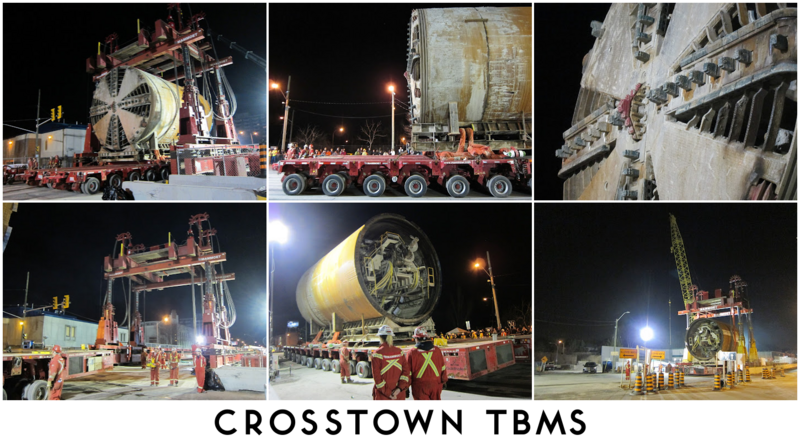
Photo gallery of Crosstown Tunnel Boring Machines extraction - April 18, 2015

My next stop: St Clair
Previous station: Woodbine

Alphabetical Station Selector

Woodbine

These days, Woodbine’s role as the original eastern terminus of the Bloor-Danforth subway line is mostly forgotten. Nevertheless, a few vestigial traces remain for the keen-eyed observer to pore over.

Streetcar tracks on Strathmore AVenue just north east of Woodbine station
Abandoned tracks on Strathmore allude to the former
streetcar loop connected to Woodbine station

Similar to Keele at the other end of the line, Woodbine sported a temporary integrated streetcar platform that connected directly with the station; this enabled a revised Danforth surface route out to Luttrell Loop. Half-buried tracks on Strathmore Blvd. physically hint at the setup.

The transfer passageway (that linked the streetcar platform to the station’s concourse level) still partially exists, but has long been walled over.

Mezzanine corridor at Woodbine station.
These doors conceal a storage room.

Since it was known that the Danforth line would continue to be extended east in a short time-frame, Woodbine was built with conventional side-loading platforms at the subway level—unlike, for example, Eglinton, with its central island configuration.

Subway train at the platform at Woodbine station
Westbound train about to depart

Woodbine station north west elevation.
Woodbine’s modest exterior


Accounts differ somewhat on the precise origin of the Woodbine name. A fuzzy approximation is that it comes from the first Woodbine Race Course at the foot of Woodbine and Queen, later called the Greenwood Raceway. The track may have been named for landowner Joseph Duggan’s Hotel, or, perhaps, his residence on the site—Duggan went on to found the Ontario Jockey Club—but some argue that the name was actually taken from the Woodbine Saloon on Yonge St., owned by William Howell, who briefly bought Duggan’s park land with a partner in 1874, to initially build the track. East-end historians, feel free to chime in and bicker.

Woodbine station opened its doors on February 25, 1966. It served as the east end of the Bloor-Danforth line until May 10, 1968, when Toronto mayor William Denison stood on the platform and closed a symbolic switch, marking the official opening of the extension east to Warden. The streetcar platform, no longer needed, was subsequently dismantled, gradually disappearing into fading memory, and the conversion of Woodbine into a humble neighbourhood way station was complete.

Update: As part of its Easier Access and 2nd Exit program, the TTC selected Woodbine for some new artwork. In the spring of 2019, Directions Connections Intersections by Jennifer Marman and Daniel Borins made its appearance, enlivening what was previously a drab bus platform with a series of metallic panels referencing “the covering of distance depicted as time and transport.”

A partial view of Directions Connections Intersections

Colourful vertical slats create a transitional rainbow effect when the work is viewed at acute angles—a nice touch. Is the piece too innocuous for the site? Maybe. But real credit has to be given for the yeoman’s effort of sprucing up what by definition is a place that people usually want to leave as soon as possible. 

Photo Gallery

Tour the station, and view captioned historical images from its past (including some nice images of the streetcar platform):

Woodbine station photo gallery

Transfer:
Transfer for Woodbine station in Toronto
Woodbine station transfer

More about Woodbine

TTC Station info | Map | Wikipedia: Woodbine

My next stop: Eglinton West (Cedarvale)
Previous station: Lawrence East

Alphabetical Station Selector

Lawrence East

Somewhat to my amusement, I discovered that the unrelenting passage of time had erased all memory of Lawrence East from my head—even though the stop was briefly my ‘home station’ many years ago.

Pedestrian tunnel beneath the rail tracks at Lawrence East station
The dismal pedestrian tunnel at Lawrence East.
Imagine walking through here every day.

Back in my halcyon university days, I once spent a merry co-op work-term programming children’s games for the Scarborough Board of Education, along with three other fresh-faced troublemakers.

Instead of working out of the main SBE office (in the Scarborough Civic Centre), we were stuck inside an anonymous, fluorescent-lit room on the second floor of the Charles Gordon Senior Public School, just south of Lawrence and Midland. To torment us, there was a radio tuned permanently to an easy-listening station, which we weren’t allowed to change: every day just past 3pm, without fail, These Eyes by the Guess Who would start playing, and we’d all croon along.

I was too lazy to commute, so I rented an apartment on nearby Prudential, a stone’s throw from the school—and from Lawrence East.

Lawrence East RT station, south east elevation
Soutbound RT departing Lawrence East station

That was a mistake, because at night-time there was precious little for a restless fellow to do in that neighbourhood—at least, that wasn’t mischief-related—so invariably I’d trudge over to the station, and take the SRT up to the mall at Scarborough Centre, or I’d head down to Kennedy and take the subway from there downtown.

Returning to the station all these years later, I realized why I could recall nothing about it: Lawrence East is a transit backwater, practically devoid of anything remarkable to reminisce about—unless perhaps you are a fan of naked, barren expanses of concrete wall.

Passenger walkway beneath the platforms at Lawrence East.
What a cheery vista for passengers

Interior of Lawrence East station
Industrial chic: a jumble of stairs, and massive roof support pillars

I’m trying to think of another station matching Lawrence East for its lack of pulchritude. My other candidates each have some redeeming qualities: e.g. due to its scale, Warden has a brutish vitality; the exterior carapaces of Glencairn and Keele conceal interiors that delight. And while Museum has been unforgivably tarted up by hooligans, at least it’s fun for the kids.

I would nominate Midland, but I already wrote that I approved of it due to its mournful ambience, so that would be hypocritical of me.

Lighting at Lawrence East station.
Hypnotizing space-age lighting. Note also the netting to keep birds from roosting in the ceiling.

Lawrence East interior waiting area.
The one pleasant image I took of Lawrence East. Enjoy.


Although Lawrence East doesn’t feature any art of its own [see update], many riders will be familiar with the landmark East Side mural, opposite the station. This distinctive mural, with its Lao Tzu quotation, has greeted northbound RT passengers since 1995. (And outliving, incidentally, the software that I wrote that term, which survived cockroach-like in Scarborough school computer labs for over a decade before it was finally retired.)

Lawrence East officially opened for service March 22, 1985 as part of the Scarborough RT line (though the station was previously used as the end point for the RT’s inaugural run from Kennedy on July 5, 1984).

Update: For the 2018 Nuit Blanche festival, Canadian-Chilean artist Shalak Attack installed an evocative vinyl mural on the platform at Lawrence East, titled Universal Language. (Fall 2018 was a fertile period for her at the TTC, as a large-scale commissioned work of hers was also unveiled at Wilson.)

Universal Language by Shalak Attack: a radiant addition of psychedelic magical realism to an otherwise dreary station


Following the event, the TTC decided to keep the art (Ellesmere and Midland also received murals, from other artists, that were retained). Maybe I’m just a sucker for visual narratives, but if any station deserved a bit of a mood booster, it was Lawrence East. Update to the update: the art was removed in 2022. Sigh.

Photo Gallery

Tour the station, and view captioned historical images from its past: (hint: turn on the captions)

Lawrence East station photo gallery

Transfer:
Transfer for the TTC's Lawrence East RT station
Lawrence East station transfer

More about Lawrence East

TTC Station info | Map | Wikipedia: Lawrence East

My next stop: Woodbine
Previous station: Davisville

Alphabetical Station Selector

Davisville

Attention: devoted subway train enthusiasts! TTC history buffs! Indulge yourself with a visit to Davisville station, an important stop on the Yonge Subway, with a rich transit legacy to explore.

Davisville station viewed from the south
Southbound train departing Davisville; the busy Davisville Yard
is to the left; above the station stands the McBrien Building.

This station is where the opening ceremonies for Canada’s first subway line were held, on March 30, 1954. Over 5,000 spectators were estimated to have attended. Not long afterwards, the TTC built its head office above the station (the structure is named the William McBrien Building, in dedication to the steadfast TTC Chairman who championed the Yonge Subway’s construction. Alas, its glory days are long past; recently CEO Andy Byford called the McBrien Building a “Stygian hellhole”).

Davisville is where the TTC situated its first subway yard, a busy complex that continues to service trains to this day.

Davisville southbound platform view
Southbound platform; the ‘Davisville Buildup’ on the right
is used by trains entering or leaving the Yard.

Railfans will enjoy watching trains shuttling in and out of Davisville Yard. Maintenance work-trains are also often on display. A prime viewing spot for this activity is from the Kay Gardner Beltline overpass, south of the station. If you have a small child accompanying you on the bridge, the conductors will occasionally sound their horn if you wave nicely to them.

When the TTC was determining where to place the yard in the late 1940’s, residents of Oriole Park feared a revival of the Belt Line railway, and objected to the secretive, almost conspiratorial process by which the TTC was making its decision.

In the end, the residents’ NIMBY concerns were mostly addressed by means of some landscaping architecture, and by reconfiguring the yard to its present north-south alignment. This alignment displaced—at considerable financial cost—the Alexander Muir Memorial Gardens, to their current location south of Lawrence.

Signal lights at Davisville station
Take a close-up look at this lovely signal, at the south end.

Davisville station platform view.
Davisville’s exposed air platform

Above the station’s main stairwell from the street, a pair of historical photographs allude to the past (browse the gallery for a peek). As well, the lobby to the McBrien Building features a commemorative plaque and photographs of every past TTC Chairperson.

The station takes its name from the village of Davisville, which itself was named for John Davis, an English potter. Starting in 1845, his thriving and expansive pottery—near the present day Yonge and Davisville—formed the commercial anchor of the incorporated village. Davis also served as the area’s first postmaster, and founded the Davisville Methodist Church. I wonder what he’d think of the station that bears his name?

Photo Galleries

Tour the station, and view captioned historical images from its past:

Photo gallery of the TTC's Davisville subway station in Toronto

Bonus gallery—a collection of archival images from the official opening ceremonies for the Yonge Subway, held at Davisville, March 30, 1954:

Gallery of photographs for the official opening day ceremonies of the Yonge subway

Transfer:
Subway transfer for the TTC's Davisville station in Toronto
Davisville station transfer

More about Davisville

TTC Station info | Map | Wikipedia: Davisville

Bonus video: The sudden view of Mt. Pleasant cemetery, when the train emerges from the tunnel on the approach to Davisville, is one of our transit system’s minor pleasures. Race those cars!


Bonus video 2: Newsreel footage of ‘S-Day’, opening day of the Toronto Subway: 

My next stop: Lawrence East
Previous station: Dufferin

Alphabetical Station Selector

Dufferin

Every-day I’m Dufferin! 

For years, that musical malapropism has been the silent mantra for stressed-out passengers jostling for the southbound 29 bus (a.k.a. The Sufferin’ Dufferin) at Dufferin station.

Something Happens Here, public art at Dufferin Station
No matter how much you squint, the pixellated splotches on the concourse walls never quite resolve...

But their transfer has finally begun to improve—both qualitatively and quantitatively—thanks to a thorough station renovation and expansion, coupled with some judicious (and long-overdue) route management.

The $30 million upgrade project, which went waaaaaay over schedule, started in 2008, began construction in 2010, and was completed in 2014. Major features included a significantly enlarged, new western entrance, secondary exits, public art, and elevators.

Dufferin station, west side entrance
The completely new west side entrance: a boon for southbound transfers

As with Pape, the upgrade controversially involved breaking the established rhythm of the Bloor-Danforth line’s historical tiling colour sequence, at the platform level. Emboldened by the 2008 vanity sacking of Museum, then-TTC Chair Adam Giambrone launched a long-term Station Modernization Program that mandated “visually modern” and “unique” station designs. The sole concession to the past was the retention of the standard Bloor-Yonge typeface for the platform signage: as if anything else would be acceptable!

Out with the old, in with the new: heritage has rarely been a priority for the TTC, when it comes to station appearance (High Park, Keele, Coxwell and Woodbine were to be spared from the carnage).

Wistful preservationist instincts aside, what’s funny to me is that the lone area in the entire station that really needed a colourful makeover—the pedestrian tunnel crossing beneath Dufferin—looks just as depressing as it did before. We gleefully erased the past, for this?

Passenger walkway beneath Dufferin street
The bleak tunnel beneath Dufferin Street: not appreciably improved.

For the public art, Eduardo Aquino and Karen Shanksi created Something Happens Here, described as: “a collection of images of the human experiences, environments, and urbanscapes from the neighbourhood, bringing a sense of place to the interior of the station and creating a distinctive experience for TTC customers.”

Large, feature art walls—abstracted from photos taken in the Bloor and Dufferin area—initially draw the attention, with strong and vibrant tones.

Tile at Dufferin station.
Yours to discover: one hundred inset stainless steel and bronze ‘memorial pixels’, distributed around the station

But it’s the scattered individual ‘memorial pixels’ that keep the piece engaging and immersive. These small, square, celebratory plaques show non-repeating images and text referencing the local neighbourhood and its identity. There are enough of them so that discovering new ones at every visit is possible.

As far as killing time goes while you’re waiting for the train, that counts as a minor win.

Dufferin station platform view
A few flecks of the old green acknowledge the past. 

Dufferin opened February 25, 1966 as part of the original Bloor line. The station is named for the third Governor General of Canada (1872-78), Frederick Temple Hamilton-Temple-Blackwood (i.e. Lord Dufferin).

Photo Gallery

Tour the station, and view captioned historical images from its past:
(hint: turn on the captions)

A photographic tour of the TTC's Dufferin subway station.

Transfer:
Paper station transfer for Dufferin
Dufferin station transfer

More about Dufferin

TTC Station info | Map | Wikipedia: Dufferin
Alternate unofficial Dufferin musical theme (as above, just substitute in ‘Dufferin’).

Afterthought: Don’t get the wrong impression—I’m not against modernizing stations. We need accessibility, safety upgrades, improved passenger flows, and more comfortable waiting areas. But the dismissive insensitivity to the original station aesthetic rankles my curmudgeonly, retrograde heart.

My next stop: Davisville
Previous station: Victoria Park

Alphabetical Station Selector

Victoria Park

When it comes to subway station renovations, it turns out that sometimes, you can put lipstick onto a pig.

Victoria Park western street entrance
The revamped street entrance to Victoria Park station

Prior to a comprehensive, multi-year, $36 million rehabilitation that culminated in 2011, Victoria Park suffered from an inefficient transfer layout. To go between the subway and the elevated slotted bus platform, you had to traverse down a flight of stairs, dash over to the correct bay, and then clamber back up again. The design was cutting-edge for a 1968 station where buses were in a separate fare zone, but it no longer served us well in the present.

And it was ugly. Wonderfully ugly! I would have rejoiced in documenting it prior to the enhancements. Externally a concrete bunker (rather like its expansion-sister Warden), Victoria Park imposed itself onto the senses, aloof to the local topography.
  
The pedestrian walkway linking Victoria Park station to Crescent Town
The Skywalk Bridge pedestrian walkway to neighboring Crescent Town 


I invariably regard ‘revitalizations’ with distaste. Progress, and the upheaval it entails, is the notional enemy of my arbitrary nostalgia for the way things were when I first encountered them. Yes, I’m one of those idiots who can’t handle change. But I can occasionally express grudging acceptance, when the improvements are clear and incontrovertible.

Pedestrian walkway along the north side of Victoria Park station
The gussied-up north-side Teesdale Place walkway 

Sloped landscaping behind the bus platform at Victoria Park
The sloped landscaping behind the perimeter bus platform references nearby Dentonia Park

Victoria Park bus platform view looking south
The soaring canopy of the bus plaza

The modernization effort strove to recast Victoria Park as a connective intermodal hub for the community. Brown+Storey Architects (known for their design of Yonge-Dundas Square) guided the site’s urban design elements; Stevens Group Architects along with the TTC’s internal team were the project architects; while Scott Torrance Landscape Architect implemented the extensive and innovative 5,000 square-foot green roof.

The makeover has been largely successful, encompassing:
  • several new and redone entrances
  • public art by environmentalist Aniko Meszaros
  • the first transit station green roof in Toronto 
  • a replacement six bay bus terminal at street-level
  • elevators for barrier-free access
  • secure storage for bicycles

'Roots' by Aniko Meszaros at Victoria Park station
Roots and its hopeful allusive statement, along the eastbound platform stairwell wall

Meszaros’ wide-ranging, somewhat rambling installation is called Roots. It takes various forms throughout the station, some better executed than others.

My personal preference is for the filigree, laser-cut panels in the north bus plaza canopy. I haven’t yet figured out the right time of year to properly view the ‘global’ shadows they cast. If you just glance up at the circles they look random, but a closer inspection reveals the reversed images of the world’s continents.

Artistic 'continental' designs in the bus canopy at Victoria Park station
Australia and Asia, flipped.

Victoria Park subway platform
Natural light floods in through the windows punched into the platform walls

Victoria Park traces its nomenclature back to the British monarch who reigned over the Empire during the latter’s era of maximum puissance. Her namesake station may never be as beloved, but thanks to the award-winning refresh, it is now far less forbidding than when its doors opened on May 11, 1968.

Photo Gallery

Tour the station, and view captioned historical images from its past:

Photo Gallery for Victoria Park subway station in Toronto

Transfer:
Victoria Park station transfer

More about Victoria Park

TTC Station info | Map | Wikipedia: Victoria Park

My next stop: Dufferin
Previous station: Yorkdale

Alphabetical Station Selector